
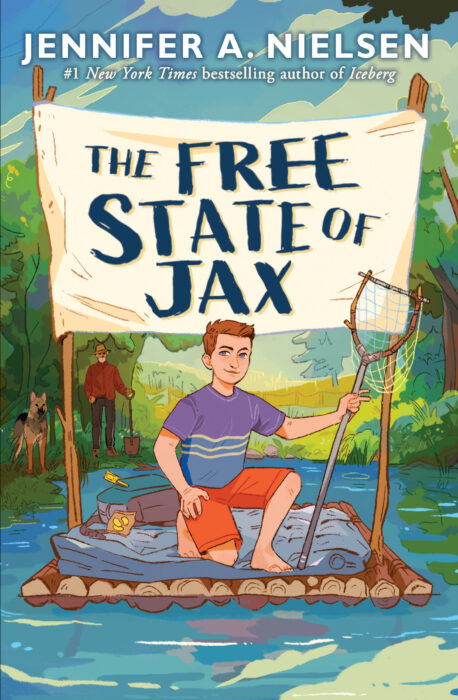
I was already intrigued by the premise of Jennifer Nielsen’s upcoming middle grade novel, The Free State of Jax – a kid establishes a micronation on property he only thinks is abandoned – when I found out that it was set in Kansas.
Besides adaptations and retellings of Little Women, the thing I am most passionate about in children’s literature is representations of rurality. Kids growing up in small towns, the middle-of-nowhere, in the country, deserve to see stories about kids just like them.
I received an ARC of this title from Scholastic at the American Library Association conference and even before I started reading I was thinking about the possibilities. Jax turns 12 in the book. I turned 12 the summer before starting seventh grade, and in Kansas, seventh graders take Kansas history where they learn about Kansas’s origins as a free state. So many parallels could be drawn between the rich abolitionist history of the state and Jax’s fight for freedom from his abusive aunt, uncle and cousins.
Unfortunately, I found this novel to be lacking in rural representation and largely uneven. Nielsen tries to balance the novel between Jax’s quest for freedom, his Aunt and Uncle’s sudden desperation to get him back, and the mystery surrounding Owen, Jax’s neighbor who owns the lake that he’s staked his nation on. Other reviews of this title have focused on its uneven plotting and pacing, so I’ll focus on rural representation.
The town, Walkonby, evokes rural stereotypes with its name alone – walk on by. Rural towns are not places to pass through, but places where people live. Nielsen appears to understand this on a surface level and Jax’s growing group of friends and the few caring adults who are settled in the town read as racially and ethnically diverse. But due to the myriad plotlines in the book, these characters are underdeveloped leaving only Jax, his family, and Owen to be more fleshed out. And Jax doesn’t want to be in Walkonby – he wants to be with his grandma whose Alzheimer’s has progressed to the point where he can’t live with her anymore. While Jax has come to see Walkonby as a place to call home by the end of the book, that doesn’t negate the name Nielsen chose.
Jax’s Aunt and Uncle and his plethora of cousins are the most stereotypically rural characters in the book. They own cows, they have a barn, they do chores, they have a large family. These characters are also unhygienic, rude to other kids, and abusive to Jax. There are many ways to be rural and to grow up in a small town, but for a rural story, there is no positive representation of a rural childhood. The other kids seem to live less rural lives and have little to no interaction or relationship to agriculture or other elements of rurality that Nielsen has attached to Jax’s family.
Owen, Jax’s neighbor, is the most sympathetic character other than Jax. He and his brother (who has disappeared) ostensibly swindled the town out of thousands of dollars to help turn their lake into a hot springs resort that would bring valuable tourism dollars to the town. I appreciated that this plot line recognizes that rural areas have value but ultimately feels like it’s written for adults – and not for the child readers who will be more invested in Jax’s bid for freedom and the mystery surrounding Owen’s brother rather than the nuances of the need for investment and infrastructure in rural communities – and the disappointments when one of your own betrays you.
The thing that disappointed me most was that this didn’t feel like a Kansas story. Walkonby could be any small town in any midwestern or southern state – I wasn’t able to place it geographically in the state, though it’s likely in eastern Kansas given that the only real place that gets mentioned is Tuttle Creek Lake in Manhattan. Owen’s lake is a hot spring, but there aren’t any naturally occurring hot springs in Kansas. The possibilities to uniquely connect this story to Kansas history never materialized like I hoped.
Let me take a minute to recommend my favorite book when it comes to highlighting great rural representation and an excellent Kansas story. Nikki Smith’s The Golden Hour, a middle grade graphic novel, is geographically specific and highlights the multiple ways in which its child characters are growing up in a rural community. When I say I want more rural representation in children’s literature, I want more books like The Golden Hour – not more books like The Free State of Jax that make a bare effort.
The Free State of Jax is out October 21, 2025 from Scholastic.
 Bookishly Bright